How to Identify a Fake Crypto Website and Protect Your Assets
By M. Webb · Published 2026-07-08 · 2044-word read
Editorial review by John Feldt, Editorial Standards Reviewer & Crypto Analyst
How this was created
How this article was created: This guide was drafted with AI assistance (claude-opus) on 2026-07-08 and edited under the M. Webb byline. Statistics attributed to CryptoKiller come from our ad-surveillance platform (measured data, not AI output); external claims cite their sources inline. Source URLs are machine-verified before publication and the draft must pass an automated quality audit before going live. Report errors to [email protected].
Scammers clone legitimate crypto exchanges with alarming precision, creating fake crypto websites that harvest credentials and drain accounts within hours. This guide walks through seven critical verification steps—from WHOIS registration checks to regulatory licensing lookups—that expose fraudulent platforms before you deposit a single dollar.

Key Takeaways
- Domain age, registrar privacy, and mismatched SSL certificates expose cloned fake crypto websites instantly.
- Legitimate exchanges publish regulatory licenses; fake platforms hide licensing status or cite non-existent jurisdictions.
- Fake crypto sites trap users with broken withdrawal systems, phantom support tickets, and synthetic price feeds.
- Verify exchange registration through official regulator databases in the jurisdiction claimed by the site.
- If you deposited funds to a fake crypto website, halt further transfers and file reports to the FTC and your bank immediately.
- CryptoKiller's tracking of 12,695 scam platforms shows domain cloning remains the fastest-scaling attack vector.
What Makes a Crypto Website Fake?
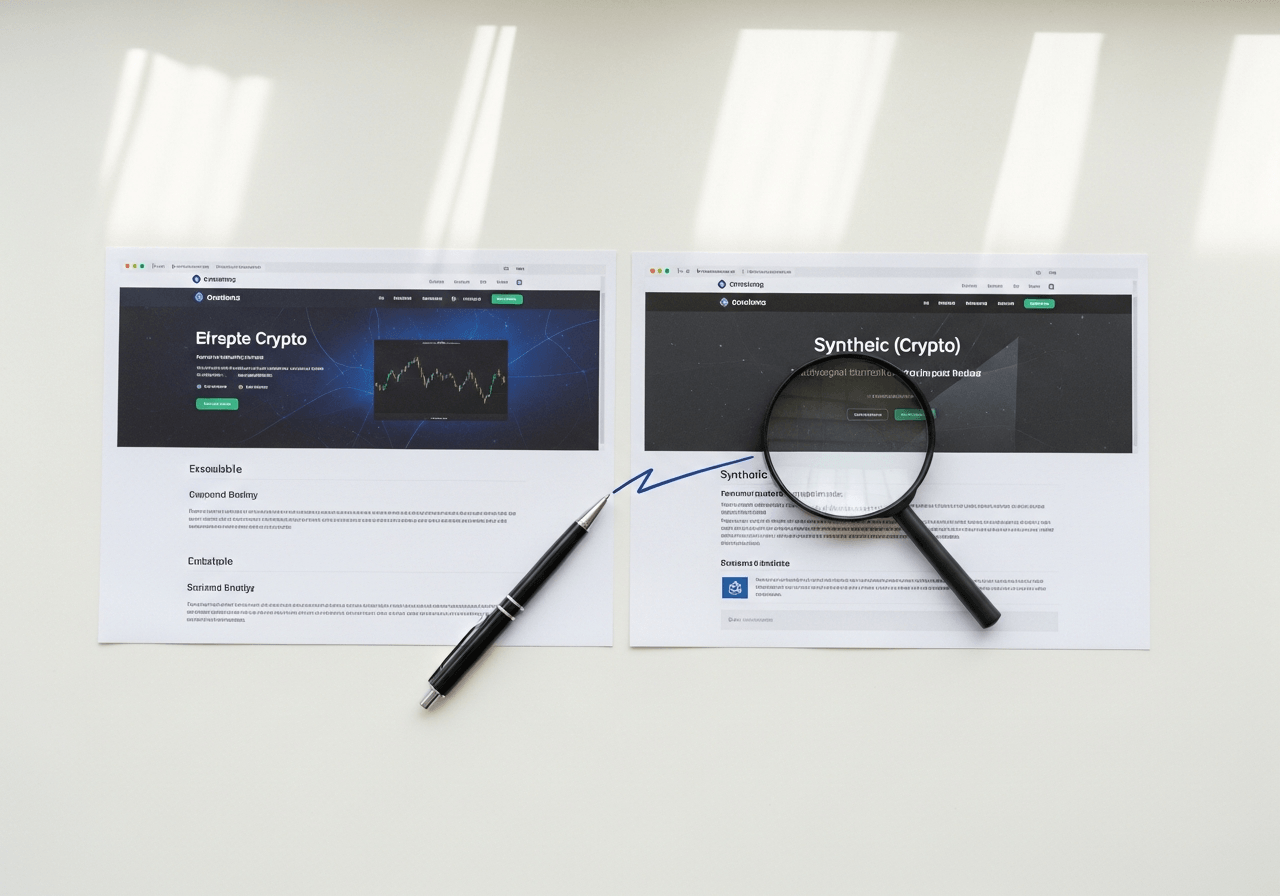
A fake crypto website mimics a legitimate exchange, wallet, or trading platform to extract deposits it never intends to return. Three categories dominate the threat data: cloned platforms, entirely fabricated exchanges, and brand impersonation sites.
Cloned platforms copy the design, logos, and login flows of real exchanges like Coinbase, Binance, or Kraken. Fabricated exchanges invent a brand from scratch, complete with fake trading dashboards and manufactured balances. Impersonation sites hijack a trusted name — a bank, a celebrity endorsement, or a government agency — to funnel victims toward deposits.
Domain registration timing separates fakes from established platforms. Scammers register domains days or weeks before launching campaigns, according to ICANN WHOIS records that expose creation dates.
CryptoKiller's analysis of 12,695 scam brands shows these sites monetize through three mechanisms: deposit theft, withdrawal freezes, and escalating fee extraction. Victims deposit funds, watch fabricated gains climb, then face demands for taxes or verification fees before any withdrawal — which never clears.

How Do Scammers Clone Legitimate Crypto Exchanges?
Scammers clone legitimate crypto exchanges by copying the target site's HTML source directly, then hosting the duplicate on a lookalike domain. The process takes minutes. A browser's "Save Page As" command captures the full front-end code — logos, fonts, layout, login forms — which attackers re-upload with minor edits to redirect deposits to their own wallets.
Three domain tricks carry the deception. Typosquatting swaps or drops letters (binancce, coimbase), inserts hyphens (crypto-com-login), or switches the top-level domain from .com to .co, .io, or .net. CryptoKiller's analysis of 12,695 scam brands shows these variations recur across thousands of fake domains.
Does the padlock icon prove a site is safe?
The padlock proves nothing about legitimacy. Free SSL certificates from providers like Let's Encrypt give any domain — including a fraudulent clone — the HTTPS padlock within seconds. HTTPS confirms the connection is encrypted, not that the operator is honest. According to ScamAdviser, encryption status is one of the weakest trust signals for a crypto site.
Visual inspection also fails. Attackers lift screenshots and interface elements straight from real platforms, so the fake dashboard, trading charts, and account pages appear pixel-perfect.

The IC3's 2024 Internet Crime Report recorded cryptocurrency fraud as the highest-loss category among investment scams, with victims reporting losses exceeding $5.6 billion — a 45% increase year-over-year. The report's methodology aggregated 859,532 complaints filed directly through ic3.gov.
— FBI Internet Crime Complaint Center (IC3), FBI IC3 Internet Crime Report 2024, published April 2025
Domain and Registration Red Flags to Check First
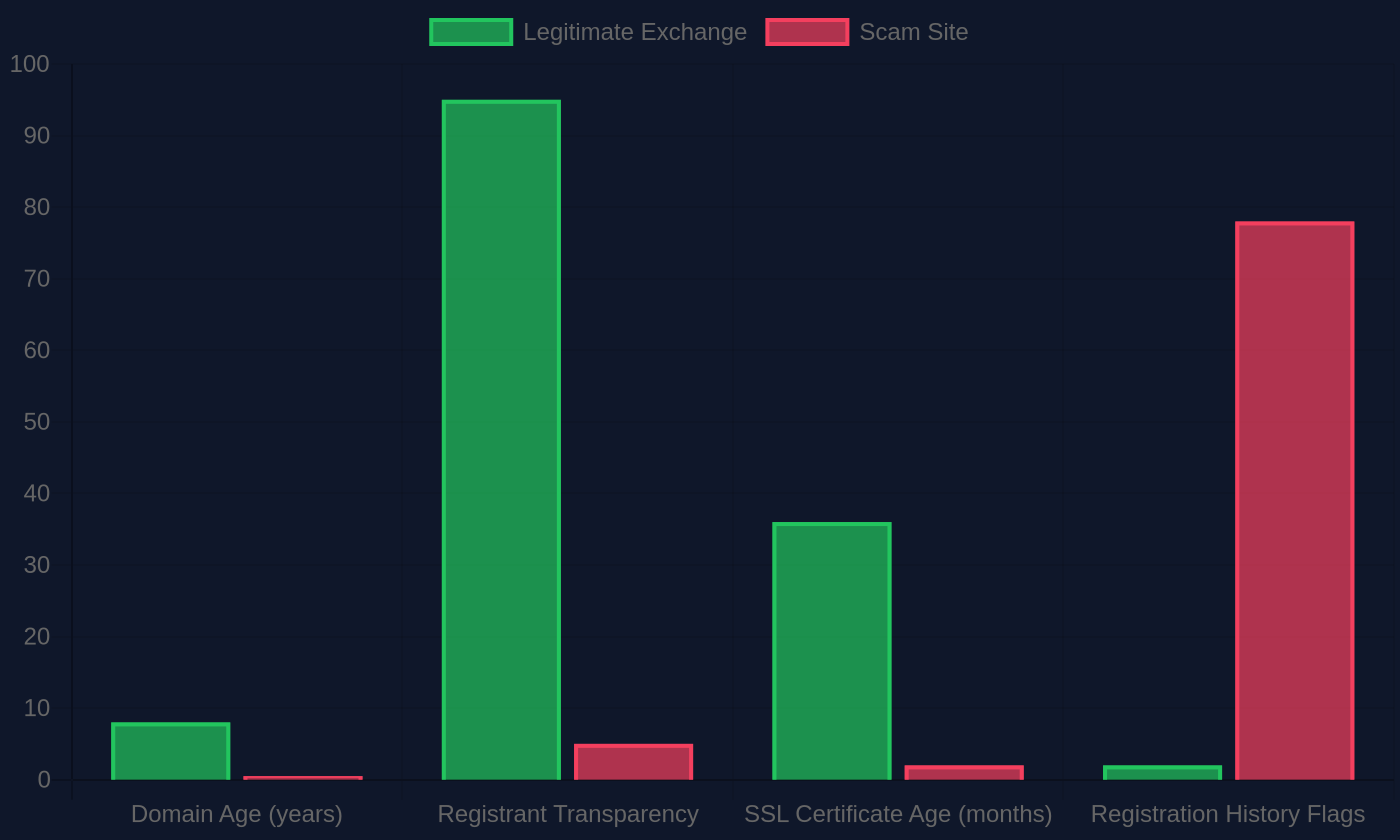
Domain age exposes most crypto scams within two minutes. A platform claiming five years of operation on a domain registered three months ago fails the first test. ICANN WHOIS at lookup.icann.org displays the exact registration date for any domain, free and instant. Any age under 6 months on a site advertising established trading history signals fraud.
Privacy-masked WHOIS records compound the risk. Scammers hide registrant names, addresses, and contact emails behind privacy proxies, then pair that concealment with no verifiable company address anywhere on the site. Legitimate exchanges register with the FCA Financial Services Register or the FinCEN MSB Registrant Search — the absence of both, combined with masked ownership, moves a site into high-risk territory.
Which free tools surface the data?
Three tools handle the full check:
- ICANN WHOIS — registration date and registrar
- ScamAdviser — a trust score aggregating server location, age, and blacklist status
- DomainTools — historical ownership and hosting changes
CryptoKiller's analysis of 12,695 scam brands shows freshly registered domains dominate the intake, most scoring near 8/100.
Which On-Site Features Signal a Fraudulent Platform?
Fraudulent platforms betray themselves through three repeatable on-site anomalies: fabricated price tickers, plagiarized legal documents, and dead support channels. CryptoKiller's analysis of 12,695 scam brands shows these markers cluster on the same sites, often within a single homepage scroll.
What UI anomalies expose fake exchanges?
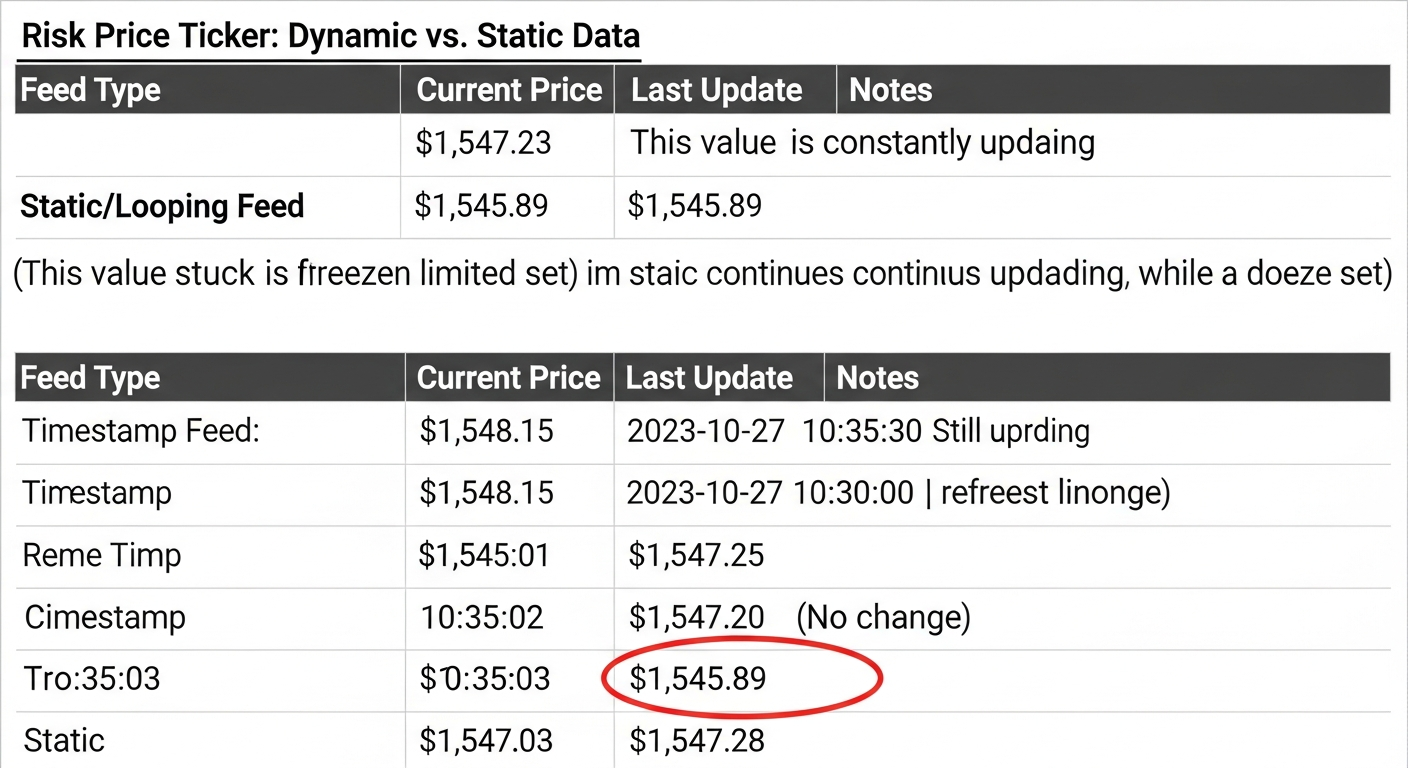
Live price tickers on confirmed fake sites display static or looping data disconnected from real market feeds. Watch a suspect ticker for 30 seconds — genuine feeds fluctuate; fraudulent ones repeat identical values or freeze entirely. Fabricated trading volume counters appear beside them, showing implausible round numbers that never move with market conditions.
Terms and conditions offer the fastest tell. Copy a distinctive sentence from a suspect site's legal page and search it. Fraudulent operators paste documents wholesale, frequently leaving the name of a different exchange embedded in the text. Team pages compound the problem — headshots trace to stock libraries or unrelated LinkedIn profiles, and "executives" carry no verifiable history.
The quick self-assessment checklist
- Price ticker loops, freezes, or shows no market movement over 30 seconds
- Terms and conditions name a different company, or match another site verbatim
- Support links return 404 errors, or live chat never connects to a human
- Team member photos reverse-image to stock catalogs or strangers
ScamAdviser's trust-scoring methodology flags HTTPS status as one of the weakest individual signals for legitimacy, noting that the majority of scam sites it processes now carry valid SSL certificates — undermining the padlock as a consumer safety cue.
— ScamAdviser, ScamAdviser Trust & Safety Checker methodology documentation, scamadviser.com
How Do Fake Crypto Sites Trap Users After Registration?
Fake crypto sites trap users by freezing withdrawals the moment a victim tries to cash out. The account shows a healthy balance and rising profits. The withdrawal button, however, triggers a demand for one more payment.
Scammers fabricate three fee types to block that cash-out: a 'tax clearance' charge, a 'security deposit,' and an 'account verification' fee. Each payment unlocks the next demand. Victims pay, expecting release, and the balance never moves.
Why do the numbers keep going up?
The dashboard inflates profits before the freeze to bait larger deposits. A victim who deposits $500 sees $4,000 within days. That fabricated gain funnels them toward a second, larger transfer. On-chain analysis shows the displayed balance is a database entry, not real funds held anywhere.
Verification loops extend the trap further. The site rejects each document, requests a new one, then demands a fee to 'expedite' review. The cycle repeats until the victim exhausts available funds.
The referral trap
Referral bonus schemes turn victims into recruiters. The platform credits fake bonuses for each friend enrolled, converting losses into recruitment incentives. This prolongs engagement and widens the victim pool.
CryptoKiller's analysis of 12,695 scam brands shows this fee-extraction sequence repeating across cloned deposit portals.
Regulatory and Licensing Checks That Expose Fake Platforms
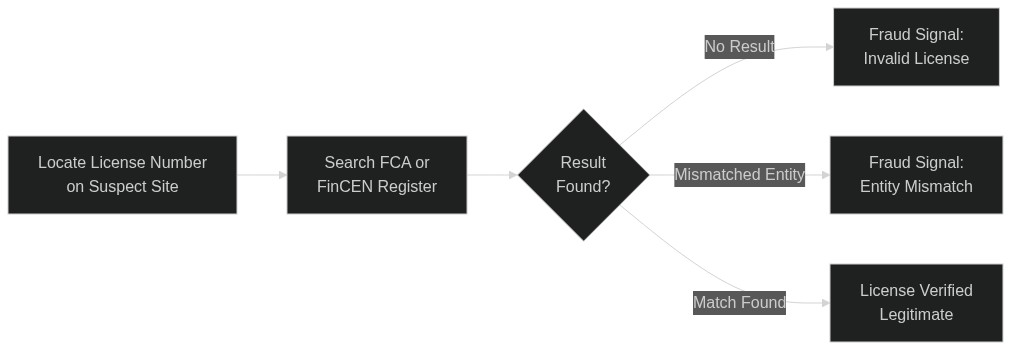
Regulator databases disprove fake license numbers in under 60 seconds. Legitimate exchanges appear in searchable government registers; fabricated credentials do not. Scammers display official-looking registration numbers that vanish when cross-referenced against the issuing authority's own tool.
Which Databases Confirm a Real License?
Three searches cover most US, UK, and EU claims:
- FinCEN MSB Registrant Search — any platform serving US customers registers as a Money Services Business. According to FinCEN's MSB Registrant Search, an absent or mismatched legal name signals fraud.
- FCA Financial Services Register — platforms claiming UK authorization appear here by firm name and reference number. The FCA register also flags cloned firms impersonating licensed businesses.
- ESMA databases — platforms citing European authorization link to a named national regulator that ESMA aggregates.
Type the displayed license number into the regulator's search box. A fake number returns no result, or returns a different company entirely.
CryptoKiller's analysis of 12,695 scam brands shows fabricated regulatory credentials as a recurring pattern across fake platforms.
FinCEN's public MSB registrant database allows any consumer to cross-reference a platform's claimed registration number against the legal entity name on file — a mismatch or absent record is treated by investigators as a primary fraud indicator.
— FinCEN MSB Registrant Search, FinCEN MSB Registrant Search public tool documentation, fincen.gov
What Should You Do If You Sent Money to a Fake Crypto Website?
Stop all further transfers immediately if you sent money to a fake crypto website. No legitimate platform requires additional deposits, taxes, or "unlocking fees" to release funds you already own. Scammers extract second and third payments by promising withdrawals that never arrive.
Preserve the evidence before it disappears
Capture everything the operators can delete. Fake sites vanish within days once complaints surface, taking transaction records with them. Save 3 categories of proof:
- Screenshots of your account dashboard, balances, and the withdrawal page
- Transaction IDs, wallet addresses, and blockchain hashes for every deposit
- All chat logs, emails, and phone numbers used by the "support" agents
Blockchain data shows crypto transfers are traceable across wallet hops, so preserved transaction IDs give investigators a starting point.
Where to file reports
Report the fraud to 3 channels the same day:
- FTC at reportfraud.ftc.gov — the federal consumer complaint intake
- FBI IC3 at ic3.gov — the Internet Crime Complaint Center that routes crypto cases to field offices
- ScamAdviser at scamadviser.com — flag the URL so the next visitor sees a warning
CryptoKiller's analysis of 12,695 scam brands shows most fake sites recycle infrastructure across dozens of domains. Reporting one URL helps analysts map the wider network before it targets others.
When This Guide Does NOT Apply
Already sent funds to a suspected fake exchange and searching for recovery options — this guide covers pre-deposit verification, not post-loss response. For that, see the recovery and evidence-preservation guides on CryptoKiller. Also not applicable if you are researching a specific named platform and need a published investigation — see the review index instead. Security researchers auditing exchange infrastructure at the code level will find this guide's scope too general for technical remediation work.
Frequently Asked Questions
How can I tell if a crypto website is legit or fake?
Verify the domain age via WHOIS lookup — newly registered domains merit immediate skepticism. Cross-check any claimed regulatory license directly in the regulator's own database, not through links on the site itself. Run the URL through ScamAdviser and check blockchain analysis platforms before depositing funds. Legitimate exchanges display transparent company registration details and respond to support inquiries through documented channels.
Does HTTPS mean a crypto website is safe?
No. HTTPS encrypts your connection to the server; it does not verify the operator's legitimacy. Free SSL certificates are available to anyone, including scammers. A padlock icon signals encrypted data transit only. Fraudulent platforms routinely deploy HTTPS to appear credible while stealing credentials and funds.
Can I recover money sent to a fake crypto exchange?
Crypto transactions are generally irreversible once confirmed on-chain. Recovery is rare but reporting to the FBI's IC3 and the FTC establishes an official record that can assist law enforcement investigations and, in documented cases, asset freezes. File reports immediately with transaction hashes and screenshots of communication.
What domains do fake crypto websites commonly use?
Scammers deploy typosquatted versions of legitimate exchange names — swapping letters or inserting hyphens. They favor alternate TLDs like .net or .io instead of the original .com. Common patterns include using similar-looking Unicode characters and registering expired domains of defunct exchanges to inherit residual search traffic.
Why do fake crypto sites ask for a tax payment before withdrawal?
This is pure fee extraction. No legitimate exchange requires users to pay taxes, security deposits, or unlock fees directly to the platform before withdrawing their own funds. Regulators and tax authorities collect payments through separate channels, never through the exchange interface. Any demand signals fraud.
Are there any official blacklists of fake crypto websites?
The FCA, CFTC, and state regulators publish warning lists on their official sites. ScamAdviser and community threat databases, including CryptoKiller's tracking of 12,695 flagged brands, aggregate suspect URLs updated near real-time. Cross-reference multiple sources before trusting any platform.
How quickly can scammers set up a convincing fake crypto site?
Fully operational clone sites go live within 24 to 48 hours of domain registration. Automated site-copying tools and pre-built scam kits enable rapid deployment with minimal technical skill. This speed explains why newly registered domains—checked via WHOIS—are a primary detection signal used by security researchers and regulators.
Sources

Prioritize CryptoKiller's scam investigations in your Google results.