How AI Trading Bot Scams Fabricate Profits and Steal Millions
By M. Webb · Published 2026-08-17 · 2172-word read
Editorial review by John Feldt, Editorial Standards Reviewer & Crypto Analyst
How this was created
How this article was created: This guide was drafted with AI assistance (claude-opus) on 2026-08-17 and edited under the M. Webb byline. Statistics attributed to CryptoKiller come from our ad-surveillance platform (measured data, not AI output); external claims cite their sources inline. Source URLs are machine-verified before publication and the draft must pass an automated quality audit before going live. Report errors to [email protected].
AI trading bot scams promise automated wealth through fake performance claims and manipulated trading data. Fraudsters exploit retail investors' desire for passive income by displaying fabricated profit screenshots, misrepresenting bot capabilities, and funneling deposits into personal wallets. This guide exposes the mechanics behind AI trading bot scams and shows you how to identify and avoid them.

Key Takeaways
- Scammers fabricate trading profits using fake account dashboards and doctored performance screenshots.
- Most AI trading bots either don't trade at all or execute deliberately unprofitable orders.
- Red flags include guaranteed returns, celebrity endorsements, and pressure to deposit immediately.
- Legitimate trading bots operate transparently and never promise fixed gains or handle your private keys.
- If scammed, document everything and report to your country's financial regulator and law enforcement.
- Verify legitimacy by checking regulatory status, trading history proof, and independent user reviews.

What Are AI Trading Bot Scams?
AI Trading Bot Scams are fraudulent platforms that claim an artificial-intelligence engine generates consistent daily trading profits with no risk. The bot does not exist. Deposits funnel into operator-controlled wallets, and the dashboard displays fabricated gains to delay withdrawal requests.
Legitimate algorithmic trading tools execute rule-based orders on regulated exchanges and disclose losses. Scam operators skip the disclosure and promise fixed returns — a claim no compliant broker makes.
Why the AI label works
Scammers exploit AI terminology because the words carry current credibility that older "cloud mining" and "forex signal" pitches lost. A machine that trades better than humans sounds plausible in 2024, and that plausibility lowers victim skepticism.
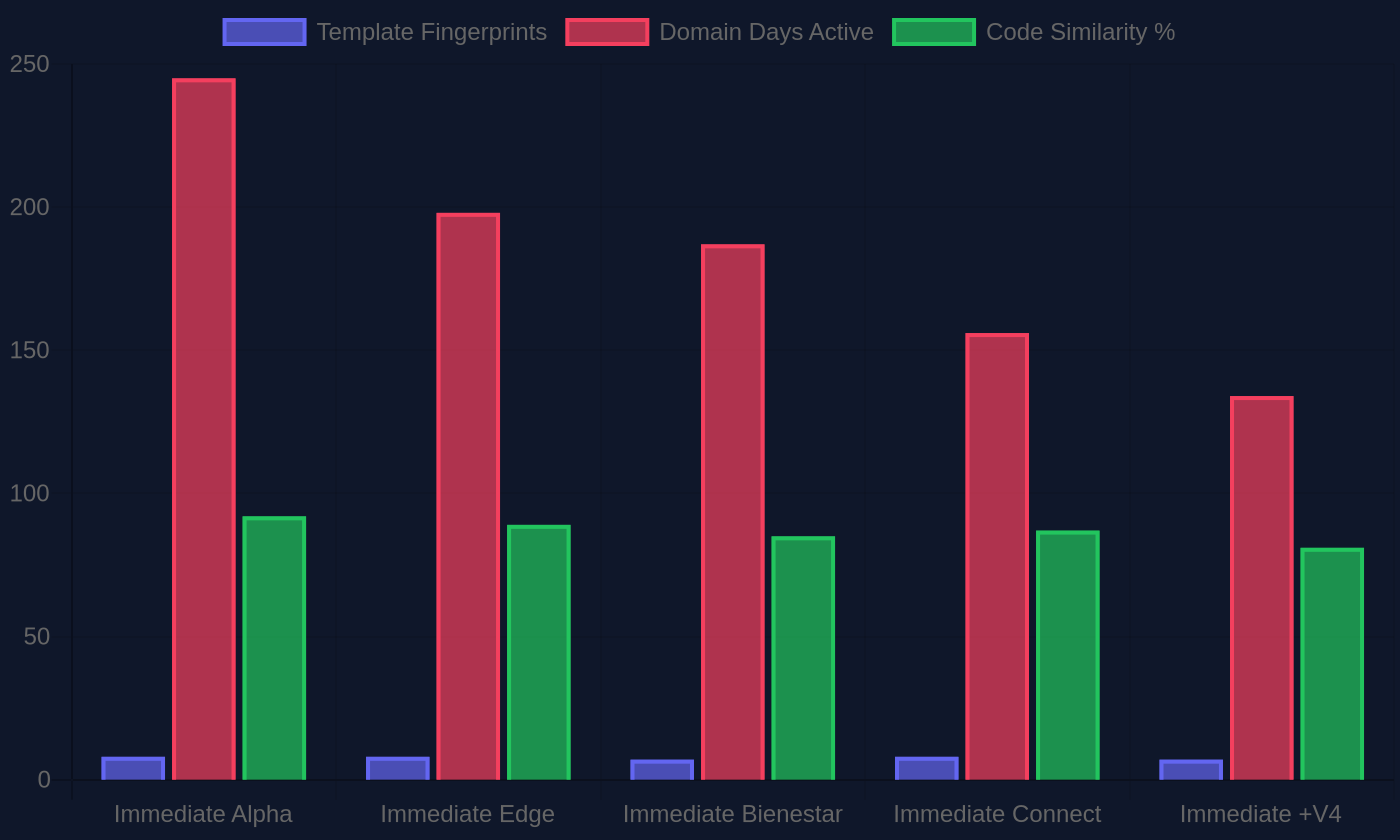
The "Immediate" naming playbook manufactures a false brand ecosystem — Immediate Alpha, Immediate Edge, and Immediate Momentum share near-identical templates while posing as distinct products. CryptoKiller's analysis across 12,695 scam brands tracked shows these clone families recycle the same funnel repeatedly, carrying an average threat score of 8/100.


How Do These Scams Actually Make Money — For the Fraudsters?
Fraudsters extract money in 3 sequential stages: deposit capture, fee extraction, and exit scam. Each stage funnels victim funds toward wallets the operators control, and blockchain data shows the movement often begins within minutes.
Stage 1: The Deposit Never Trades
Fake platforms accept crypto or fiat, then immediately move the funds off-platform. The dashboard displays an AI bot generating steady returns, but no trade executes. On-chain analysis frequently traces deposits to consolidation wallets that pool money from hundreds of victims before laundering it through mixers or exchanges.
Stage 2: The Withdrawal Fee Trap
Victims who request a payout hit a wall. Operators demand a 'tax', 'insurance premium', or 'liquidity fee' to unlock fabricated profits. The FTC and FBI's IC3 both document this pattern: each payment funds nothing, and each success prompts a new demand. Victims chasing sunk costs pay repeatedly.
Stage 3: The Exit Scam
Platforms vanish once deposit volume peaks, typically within 3 to 6 months of launch . The website goes dark, support channels close, and the operators rebrand under a new domain.
CryptoKiller's analysis of 12,695 scam brands carries an average threat score of 8/100, and this deposit-fee-exit sequence recurs across most of them.
IC3's annual reporting documents the withdrawal-fee trap as a recurring pattern across cryptocurrency investment fraud complaints, where victims make multiple sequential payments chasing sunk costs before abandoning the platform.
— FBI Internet Crime Complaint Center (IC3), FBI IC3 Internet Crime Report, ic3.gov — annual complaint data
How Do Scammers Fabricate Trading Profits?
Scammers fabricate trading profits through interface illusions that display activity no market ever executed. The dashboard becomes the entire crime scene. Victims watch numbers climb while no capital moves, no exchange fills orders, and no broker records a single position.
The Fake Dashboard Mechanism
Fraudulent platforms render 'live trades' from scripted loops, not order books. Blockchain data shows deposits flowing to a single collection wallet while the front-end animates gains against fictional tickers. Three components carry the deception: real-time trade tickers pulling from random-number generators, balance counters that increment on a timer, and 'win rate' badges hard-coded above 90%.
Referral mechanics inflate visible balances without any payout leaving the operator's control. The account shows a bonus; the withdrawal button returns an error. According to the FBI's IC3, this recover-your-funds dead-end defines most bot fraud complaints.
Manufactured Social Proof
Scammers fabricate credibility through three recycled assets: AI-generated profit screenshots, cloned celebrity endorsements, and testimonial actors reading scripts. CryptoKiller has recorded 6,388 brands using celebrity impersonation across a portfolio carrying a 8/100 average threat score.
Red Flags That Identify an AI Trading Bot Scam
Guaranteed returns identify a fraudulent AI trading platform faster than any other signal. Legitimate trading carries loss; scam operators promise fixed profits like "3% daily" or "90% monthly" that no automated strategy sustains. The FTC and FBI's IC3 both log guaranteed-return language as a recurring fraud marker in investment complaints. CryptoKiller's analysis across 12,695 scam brands tracked shows these promises cluster with an average threat score of 8/100.
Three observable indicators separate a scam from a regulated service:
- No verifiable identity. The platform lists no company registration, no physical address, and no named developers. A reverse search on ScamAdviser often returns a domain registered within the past 90 days.
- Pressure tactics. Countdown timers, "limited allocation" offers, and unsolicited "broker" cold calls arrive within hours of signup. The urgency exists to stop victims from researching.
- Withdrawal friction. Deposits clear instantly; withdrawals stall. Operators block payouts, demand a "tax" or "unlocking fee," or request a second deposit before releasing funds that never arrive.
The withdrawal test is the decisive one. Deposit a small amount, then attempt to withdraw it before adding more. A platform that invents new fees at that moment is extracting, not trading.
ScamAdviser's consumer protection references identify domain age, anonymized hosting origin, and absence of verifiable company registration as clustering warning signals for AI trading bot platforms, with most fraudulent domains registered within 90 days of first contact with victims.
— ScamAdviser, ScamAdviser Consumer Protection References — AI Trading Bot Scams, scamadviser.com
Who Gets Targeted and Why AI Scams Work So Well
Retail investors new to crypto absorb the heaviest losses in AI trading bot schemes. These victims conflate AI marketing with genuine financial technology, treating "algorithmic" and "machine-learning" labels as proof of returns they cannot independently verify. Both the FTC and FBI IC3 track investment fraud complaints where victims cite automated trading promises as the deciding factor.
Why does the AI framing work?
Scammers exploit authority bias. An AI bot presents perceived technical superiority the victim has no ability to audit — no code, no track record, no third-party verification. Scarcity messaging compounds this: limited "seats", closing enrollment windows, and countdown timers pressure deposits before scrutiny. CryptoKiller's analysis of 105,980 ad creatives shows these tactics recur across the 12,695-brand portfolio.
How victims become recruiters
Referral programs turn existing victims into unwitting recruiters. A depositor who sees a fabricated dashboard balance invites friends, family, and colleagues, lending the operation social proof no ad can match. ScamAdviser documents this pattern across consumer complaints.
What Should You Do If You've Been Scammed by an AI Trading Bot?
Document everything before you contact anyone. Screenshots of the platform dashboard, the deposit wallet addresses, transaction IDs, and every message from the operator form the evidentiary record investigators need. Blockchain data cannot be altered once recorded, so preserving the exact transaction hashes matters more than any promise the platform made.
Where to file reports
File with two federal channels first. The FTC accepts consumer fraud complaints at reportfraud.ftc.gov, and the FBI Internet Crime Complaint Center takes cryptocurrency-loss reports at ic3.gov. Report to the exchange that processed your outbound transfer as well — Coinbase, Kraken, and Binance operate compliance teams that flag receiving addresses tied to fraud.
Beware the second wave
Recovery scams target prior victims within weeks of the original loss. These operators impersonate law firms, blockchain forensics firms, or government agents, then demand an upfront fee to "unfreeze" or trace your funds. No legitimate recovery service requires advance payment in crypto. CryptoKiller's analysis across 12,695 scam brands shows recovery fraud recycling the same wallet infrastructure that funneled the initial deposits.
Acting within 72 hours gives exchanges the best chance of flagging funds still in transit.
The FTC's fraud reporting infrastructure at reportfraud.ftc.gov logs guaranteed-return language as a primary marker in investment fraud complaints, consistent with the fixed-percentage daily return promises documented across AI bot scam brands.
— FTC — Federal Trade Commission, FTC Report Fraud portal — reportfraud.ftc.gov, consumer complaint taxonomy
How to Verify Whether an AI Trading Bot Is Legitimate
Verifying an AI trading bot starts with three checks: regulatory registration, an audited track record, and independent domain analysis. Legitimate platforms carry a license from the SEC, FCA, or ASIC. Search the regulator's own public database for the firm's name before depositing — an unregistered entity that promises guaranteed returns is a fraud marker.
Does the bot show a verifiable trading history?
Audited performance data appears on third-party trackers, not on self-reported dashboards. Fraudulent operators fabricate profit screenshots, backdate returns, and hide losing trades. A bot that publishes an independently auditable record — with drawdowns, fees, and losing periods intact — passes this test. One that only shows upward curves fails it.
What do domain and hosting signals reveal?
Domain age exposes most scams within seconds. ScamAdviser assesses registration date, hosting origin, and trust signals; a domain registered weeks ago and hosted through an anonymizing service is a warning sign, according to ScamAdviser's consumer protection references.
CryptoKiller's analysis of 12,695 scam brands, carrying a 8/100 average threat score, shows these three failures cluster together. Report suspected fraud to the FTC at reportfraud.ftc.gov and the FBI's IC3.
When This Guide Does NOT Apply
This guide is preventive, not remedial — if you have already lost funds and are seeking recovery options, see our dedicated recovery scam warning at /blog/asset-recovery-scam before contacting any third party. It also does not apply to readers researching legitimate algorithmic trading platforms, high-frequency trading infrastructure, or DeFi protocol risks — those topics carry distinct threat profiles not covered here. If you are already running the withdrawal test described in Section 4 as standard practice, you are operating above this guide's baseline.
Risk Disclosure and Editorial Independence
This article is published for general information and harm-reduction purposes only. It is not financial, investment, legal, or tax advice, and nothing in it is a recommendation to buy, sell, or hold any asset. Crypto-asset trading carries a high risk of total loss, and money sent to a fraudulent operator is frequently unrecoverable. Verify any platform independently with your national financial regulator before depositing funds, and consult a licensed professional about your own circumstances.
CryptoKiller is an independent scam-intelligence publication. Some links on this site are affiliate links that may earn us a commission at no additional cost to you; commercial relationships never influence our verdicts or risk ratings. If you believe you have been defrauded, report it to your national financial regulator and to law enforcement (in the United States, ReportFraud.ftc.gov and IC3.gov).
Frequently Asked Questions
Are AI trading bots ever legitimate?
Legitimate algorithmic trading tools exist and institutional traders use them daily, but they operate under strict regulatory oversight and never promise guaranteed returns. Registered firms disclose risk, maintain auditable records, and allow fund withdrawal without penalty. The scam variants collapse this transparency entirely—they guarantee profits, hide ownership, and trap capital behind fabricated fees.
How do I know if an AI trading bot platform is a scam?
Guaranteed profit claims are the primary indicator. Secondary red flags: withdrawal requests that incur sudden fees, company registration data that doesn't exist in public records, developers listed anonymously or under fake names, and testimonials from stock photo models. Legitimate platforms disclose risk and allow free withdrawals.
Can I get my money back after an AI trading bot scam?
Recovery is difficult but enforcement actions have returned funds to victims. File reports with the FTC at reportfraud.ftc.gov and the FBI IC3 at ic3.gov immediately—these complaints trigger multi-agency investigation. Avoid paid recovery services; they're almost always secondary scams. Preserve transaction records and blockchain addresses for law enforcement.
Why do so many AI trading bot scams use the word 'Immediate' in their name?
The 'Immediate' prefix is deliberate brand hijacking. Scammers register variants—Immediate Edge, Immediate Profit, Immediate Connect—to capture search traffic and exploit name recognition from earlier defunct platforms. Each shut-down domain simply spins up under a new 'Immediate' variant, cycling victims and obscuring the criminal continuity.
What is the difference between a Ponzi scheme and an AI trading bot scam?
AI trading bot scams often function as Ponzi schemes structurally. Early depositors see apparent gains (fake account statements) funded by later victims' money, not actual trades. When deposits slow, the platform vanishes. The key difference is the false narrative: Ponzi schemes admit pooled investment; trading bot scams fabricate autonomous profit generation that never occurred.
Where should I report an AI trading bot scam?
Report to three authorities simultaneously: the FTC at reportfraud.ftc.gov, the FBI Internet Crime Complaint Center at ic3.gov, and your national financial regulator. Include transaction hashes, platform URLs, deposit addresses, and screenshots of fake account statements. Multi-agency reports create enforcement dossiers faster than single-agency complaints.
Sources

Prioritize CryptoKiller's scam investigations in your Google results.